Home › Asphalt Resurfacing & Overlays
Renew your worn driveway with asphalt resurfacing in Garland, TX instead of full replacement. We repair problem areas, then install a smooth asphalt overlay that refreshes the look of your property and restores driving comfort at a lower cost.
Precision Asphalt Garland provides professional asphalt resurfacing throughout Garland, TX, Texas and the surrounding area. Our licensed, insured crew delivers safe, clean, on-time work with a free estimate before anything begins. Call (469) 949-1928 or request your free quote.
Asphalt Resurfacing & Overlays in Garland, TX
Garland traffic, hot summers, and sudden downpours are hard on asphalt. Over time, the surface dries out, cracks, and starts to ravel even if the base is still solid. Asphalt resurfacing gives your driveway, parking lot, or private road a new driving surface without paying for a full tear out and rebuild.
At Precision Asphalt Garland, we focus on resurfacing and overlays that are tailored to North Texas conditions. We look carefully at your existing pavement, the traffic it carries, and drainage patterns on your property. If the base is stable, an overlay can restore a smooth black finish, extend the life of your pavement by 8 to 15 years, and improve curb appeal for a fraction of full reconstruction cost.
We regularly resurface neighborhood driveways, church lots, small business parking areas, and light industrial yards in Garland, Rowlett, and the northeastern Dallas area. Our crew explains what can be resurfaced and what needs deeper repair so you are not paying for a bandage on a failed base.
When Resurfacing Is the Right Choice
Not every cracked surface is a candidate for asphalt resurfacing. The first thing we check is whether the base and subgrade are stable. In Garland, we often see movement from clay soils that swell when wet and shrink when dry. If your pavement has widespread deep depressions, pumping mud at cracks after rains, or large sections that flex when heavy vehicles roll over, resurfacing alone will not hold up. Those areas usually need full-depth repair.
Resurfacing is typically a good option when:
• Cracks are mostly surface level and have not opened into wide gaps.
• Potholes are scattered and shallow, not clustered throughout the lot.
• There is minor rutting in drive lanes but no severe waves or buckling.
• The surface looks gray and dry, with raveling or light pitting, while the structure underneath is firm.
We walk the site with you and mark areas that need patching, milling, or base repair before any overlay. By separating cosmetic wear from structural failure, Precision Asphalt Garland can tell you honestly whether resurfacing will perform well for the next decade or if your money is better put toward reconstruction in certain sections.
Our Asphalt Resurfacing & Overlay Process
A quality overlay is more than just spreading a new layer of asphalt. The long term success of resurfacing comes from preparation and careful attention to transitions. Our typical process in Garland looks like this:
1. Inspection and measurements. We start with a visual inspection, simple probing of soft spots, and measurements of existing pavement thickness where needed. We note drainage paths, low spots, and high traffic areas such as dumpster pads and drive lanes.
2. Cleaning and surface prep. We use mechanical broom sweepers and blowers to remove loose rock, dust, and debris. Oil spots are scrubbed and treated with bonding agents so they do not cause future delamination.
3. Crack and pothole repair. Wider cracks are cleaned out and filled with hot pour crack sealant. Potholes and localized failures are saw cut, the failed material is removed, the base is compacted, and new hot mix asphalt is installed flush with the old surface. If sections have significant rutting, we may mill those areas to re-establish proper profile.
4. Leveling course (if needed). On older Garland lots with birdbaths or tire ruts from delivery trucks, we often install a thin leveling course of hot mix asphalt first. This corrects drainage and provides a uniform surface so the final overlay wears evenly.
5. Tack coat application. We apply an asphalt emulsion tack coat to the existing pavement. This step is critical, especially in our hot climate, because it bonds the new overlay to the old surface and helps prevent slippage or shearing.
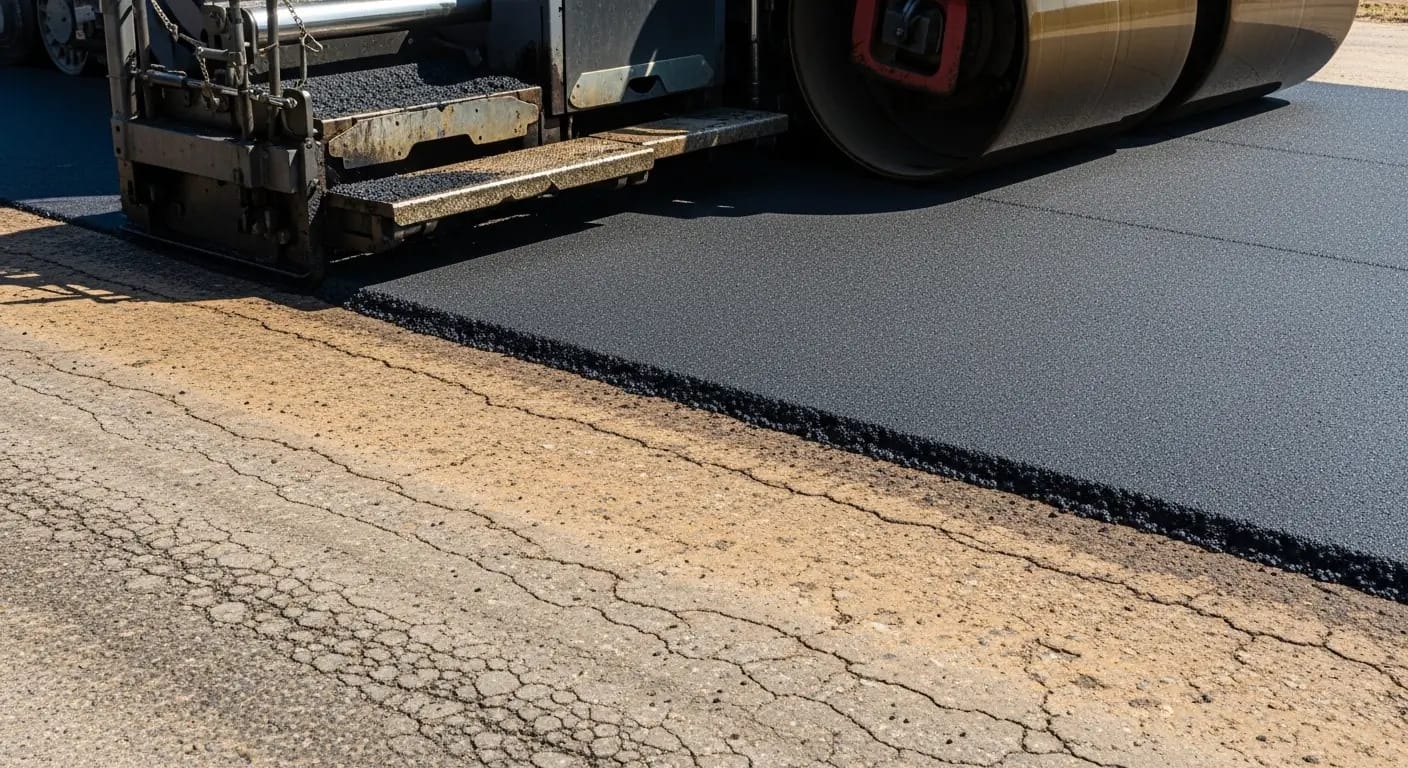
6. Installing the overlay. Hot mix asphalt is delivered from the plant at the proper temperature, placed with a paver, and compacted with steel drum and pneumatic rollers. For most parking lots, overlay thickness ranges from 1.5 to 2 inches. Heavier traffic areas may receive thicker sections or multiple lifts.
7. Transitions and tie ins. At entrances, sidewalks, and around drainage inlets, we mill or taper edges so the new surface meets existing concrete without creating tripping hazards or steep bumps. These transition details are especially important on older Garland properties that have settled over time.
8. Striping and clean up. After the asphalt has cooled, we re-stripe parking spaces, ADA stalls, directional arrows, and fire lanes so your lot is ready for use. The crew leaves the site clean with no loose mix or trash left behind.
Material Options Built for North Texas Heat
Not all asphalt mixes perform the same way in Garland weather. Our region sees high summer temperatures, UV exposure, and heavy rain events. Precision Asphalt Garland works with local asphalt plants to specify mixes that handle this combination of heat and intermittent loading.
For overlays, we typically recommend dense graded hot mix asphalt with a performance grade binder suited to North Texas. This type of mix resists rutting in drive lanes and stands up well to daily temperature shifts. On lots that see regular heavy trucks, such as small distribution centers or auto shops, we may recommend a mix with a stiffer binder and thicker overlay in truck paths only. This lets you save money in low traffic areas while reinforcing the zones that take a beating.
Surface texture can also be tailored. A slightly coarser surface offers better traction and drains water faster during sudden Texas storms. For residential driveways, a finer surface provides a cleaner, more finished look. We also coordinate with property owners on whether to add a sealcoat after the overlay has properly cured, usually several months later, to further protect against oxidation and fuel spills.
If you have concerns about noise, tracking, or how hot the surface gets in direct sun, we can discuss mix selection, pavement color options through sealcoat, and drainage improvements that make your paved areas more comfortable to use.
What Affects the Cost of Asphalt Resurfacing
Homeowners and property managers in Garland often call us asking for a per square foot price over the phone. While we can give rough ranges, the real cost of asphalt resurfacing depends on several site-specific factors.
Key cost drivers include:
• Existing condition. Lots with many potholes, deep cracks, or base failures require more patching and milling before an overlay. Prep work can represent a significant portion of the budget.
• Overlay thickness. A typical 1.5 inch overlay costs less than a 2 or 3 inch overlay simply because of material volume. Heavier traffic areas may need thicker lifts to perform well.
• Drainage corrections. If we need to mill high spots, add leveling courses, or fix long standing birdbaths at entrances, there is additional labor and machine time.
• Layout complexity. Properties with many islands, tight drive lanes, and handwork around curbs take more time than wide open areas where a paver can run efficiently.
• Access and phasing. If a busy Garland business must stay open during work, we may stage the project in multiple phases with additional mobilizations, which impacts project cost.
During an on site visit, Precision Asphalt Garland measures the area, identifies required repairs, and explains each cost component so you understand where your money is going. We also help you prioritize, for example focusing on customer parking and main drive lanes now and scheduling auxiliary areas for a later phase if needed.
Common Overlay Problems and How We Prevent Them
Most early failures in asphalt overlays come from skipping steps or ignoring underlying issues. Our crew has resurfaced many Garland lots that failed prematurely under other contractors because the base problems were not addressed or the overlay was too thin.
Common problems we look out for include:
• Reflective cracking. Existing cracks in old pavement can reflect up through the new overlay. We reduce this risk by properly cleaning and sealing larger cracks, using a leveling course where needed, and choosing appropriate overlay thickness. While no overlay can completely eliminate reflective cracking, good preparation slows it down.
• Slippage and shoving. Without a proper tack coat or with an overly smooth base surface, overlays can slide and create ripples, especially in braking zones. Our crews are trained to apply tack at the right rate and ensure full coverage, and we adjust compaction patterns to avoid pushing mix in hot weather.
• Poor drainage at transitions. New overlays that are not tied in correctly to concrete or existing pavement can trap water. Standing water shortens pavement life and creates safety issues. We take time to mill or taper edges and use a laser or stringline to confirm slope in critical areas.
• Edge breakup. On driveways and narrow private roads without curbs, thin edges can crumble under vehicle tires. We often recommend a slight widening or careful shoulder support during resurfacing so the new edge is not left hanging in soft soil.
By focusing on these details, Precision Asphalt Garland helps your resurfaced pavement hold up through cycles of Texas heat, stormwater, and daily traffic.
Planning Your Asphalt Resurfacing Project in Garland
Scheduling and traffic control are just as important as the paving work itself, especially for active businesses, HOA communities, and churches. Before we begin, we sit down with you to plan work zones, access routes, and timing so your property can continue operating safely.
In many Garland parking lots, we can mill, patch, and pave one half at a time so customers always have somewhere to park. For residential streets and private drives, we coordinate with residents about temporary parking locations and expected cure times. Typically, light vehicle traffic can return within 24 hours, although heavy trucks may need to wait longer depending on temperature and mix.
We also help you think ahead. If you plan to add dumpsters, deliveries, or new building areas in the next few years, we may reinforce those access routes now while resurfacing the rest at standard thickness. This kind of planning reduces future patchwork and keeps your pavement looking uniform.
If you are considering asphalt resurfacing in Garland, TX, Precision Asphalt Garland will provide a straightforward evaluation of your pavement, a clear written scope, and a work plan that fits your operation. Our goal is to extend the life of your pavement with smart overlays that respect both your budget and the way your property is actually used every day.